FAQ
Frequently Asked Questions
What is the Accra-Tema Motorway & Extensions Project?
The Project consists of three distinct road links that function together to move traffic between Tema Port, Accra and its surrounding urban and peri-urban areas. The scope of the project comprises roads constituting a 27.7km long road network made up of:
- Section 1: Tema Roundabout to Tetteh Quarshie Interchange — 19.5km (N1)
- Section 2: Tetteh Quarshie Interchange to Apenkwa Interchange — 5.7km (N1)
- Section 3: Apenkwa Interchange to Neoplan Junction — 2.5km (N6)
On completion, the Project will have a 10-lane Section 1, 12-lane Section 2, and a 6-lane Section 3. In addition, the Project will have five (5) new interchanges and two (2) remodelled interchanges (Tetteh Quarshie and Apenkwa).
What informed the decision to assign the Project to the Ghana Infrastructure Investment Fund (GIIF)?
Government’s strategic decision is premised on these pillars:
- The PPP Act provides for a project to be procured through GIIF when a competitively procured tender process falls through;
- GIIF has the capacity to raise complementary long-term financing to deliver the Project on behalf of the Ghanaian people;
- It fits within GIIF’s mandate, as Ghana’s sovereign wealth fund for infrastructure, to catalyse the development of critical infrastructure in Ghana;
- To deliver a local solution to a local problem by utilising Ghanaian expertise, capital and institutions.
Who is GIIF and who are the shareholders?
GIIF was established to resolve a problem most African countries have experienced — how to unlock more private sector financing to fund and solve infrastructure deficits.
GIIF was established pursuant to the Ghana Infrastructure Investment Fund Act, 2014 (Act 877) with a mandate to identify, develop, invest, mobilise and manage investments in a diversified portfolio of infrastructure assets in Ghana for national development, in a profitable and sustainable way. GIIF is 100% owned by the Government of Ghana.
GIIF has not only relied on the initial funding it received from government. It has also raised US$160M of long-term debt financing from two premier global financing institutions, without a sovereign guarantee.
What is the structure of the transaction?
The Ministry of Roads and Highways, acting through the Ghana Highway Authority as Contracting Authority, has awarded a 30-year concession to A.T. Expressway Ltd (the Concessionaire or “ATEL”) under a Concession Agreement.
Under the Concession Agreement, ATEL is responsible for the design, finance, build, operation and maintenance of the project. ATEL has signed a FIDIC Silver Book EPC Contract for the design of the three sections and the construction of the Section 1 Works. On expiry of the concession, the road and ancillary assets will be transferred to the Ghana Highway Authority.
- Government is responsible for acquiring additional land and resettling Project-Affected Persons.
- The Ghana Highway Authority is responsible for relocating utilities within the corridor, and also acts as Employer’s Representative for the Section 1 Works, with Associated Consultants Limited as Employer’s Representative’s Agent.
- The Ministry of Finance funds applicable taxes on the Section 1 Works.
To recoup its investment, ATEL will toll Sections 1 and 2 only, but will operate and maintain all sections for the period of the concession, and will pay concession fees to Government through the Ghana Highway Authority.
Who is the Concessionaire and who are the shareholders?
ATEL is the Concessionaire and is currently owned by GIIF. ATEL is currently raising equity and debt financing under the PPP structure to increase private participation in the project.
Has the Concession Agreement been approved?
Pursuant to the Public Private Partnership Act 2020 (Act 1039), the Concession Agreement has been approved by the PPP Committee and Cabinet. Parliament granted its approval of the Concession Agreement on 15th December 2023 in accordance with the Act.
Who is going to construct the road?
The responsibility for engineering, procurement and construction is that of the Concessionaire, which transfers those obligations and risks to an EPC contractor through a FIDIC Silver Book EPC contract.
As Concessionaire, ATEL has awarded the contract for Phase I to Maripoma Enterprise Limited under a FIDIC Silver Book EPC Contract. Maripoma is responsible for the design of the three sections of the project and the construction of the Section 1 Works only. The Phase 2 EPC (Sections 2 and 3) and the Operation and Maintenance procurement packages are being developed.
Is the Project going to be delivered in phases?
The Project will be delivered in two phases:
- Phase I is Section 1 — the Accra–Tema Motorway (19.5km).
- Phase II comprises Section 2 — George Bush Highway (5.7km);
- Section 3 — a portion of the Nsawam Road (N6) linking to the N1, from Neoplan Interchange to Apenkwa (2.5km);
- and the Operation and Maintenance of the Project.
Why is the FIDIC Silver Book being used?
The FIDIC Silver Book is often preferred in EPC/Turnkey projects, particularly those that are project-financed, because it provides a high degree of cost and time certainty. This is achieved by allocating most of the project risks to the contractor, including design and completion risks, which makes it attractive to lenders who want to minimise financial exposure.
Lenders require greater certainty about a project’s final costs as part of due diligence on bankable projects. The traditional allocation of risks in contracts such as FIDIC’s Red and Yellow Books results in final cost uncertainties that tend to make lenders wary of construction risk and its related cost.
In response, the Concessionaire negotiated and awarded a Silver Book EPC contract to Maripoma Enterprise Limited to provide certainty of construction contract costs for Phase I.
What is the cost of the ongoing construction work?
The Concessionaire has signed an EPC contract for Phase I which covers the design of the entire 27.7km project and the construction of the 19.5km Section 1 Works. The construction of Section 1 covers 36 months (including a period for detailed design) for a maximum of US$340M, exclusive of applicable taxes.
Who is Maripoma Enterprise Limited?
Maripoma Enterprise Limited is a private limited liability construction company incorporated in Ghana and is the Phase 1 EPC Contractor. It is a fully indigenous Ghanaian company with a multi-million construction portfolio handling projects in Ghana and beyond.
When would the Accra-Tema Motorway be completed?
Phase 1 is currently ongoing. The design and construction of Section 1 — which includes the Accra–Tema Motorway, three new interchanges at Teshie Link, Lashibi and Community 18, and extends to Accra Polo Club and Emmanuel Eye Clinic — would be completed in 36 months ending August 2027.
What are the benefits, if any, of this structure?
This ambitious project is Ghana’s first toll road PPP and provides a structure that gives the Ghanaian people a significant stake in the Project. The PPP structure will provide accountability and private sector participation in this significant road infrastructure. The Project presents a secure investment opportunity for institutions and investors seeking viable long-term investment. Its successful implementation will set the tone for similar PPPs in Ghana and beyond.
- Once built and de-risked, the project can be refinanced by local investment institutions such as pension funds, allowing the initial Government funds to be repaid or used to fund future road projects.
- Financial benefits accrue to Government. GIIF owns the Project on behalf of the Ghanaian people, and therefore accrues significant financial benefits on their behalf.
- The PPP structure allows for the involvement of key local financial institutions.
- A concession fee is payable to Government throughout the operational life of the concession.
Is the project a PPP?
In 2020, Government, acting through the Ministry of Finance, requested GIIF to develop a GIIF-led PPP solution for the delivery of the Project, leveraging Government anchor capital in the form of a construction grant (Viability Gap Funding) by raising maximum funds from the market. This mandate resulted in GIIF incorporating ATEL as an initially wholly owned private entity to develop, finance, build, operate and maintain the project.
Under the Public Private Partnership Act 2020 (Act 1039), the Ministry of Finance is providing ATEL with viability gap funding in the form of a construction grant as initial financial support. This is Government’s intervention to ensure tolls are affordable to the Ghanaian road user and to ensure commercial viability for investors. GIIF is also providing initial equity to ATEL for the accelerated delivery of the project.
ATEL, post construction of the road, will sell down a significant portion of its equity to institutional investors, such as pension funds, which require safe and secure long-term investments. This PPP structure provides transparency, accountability, risk sharing, and a clear legal and institutional framework.
Is my route affected?
The design corridor is 27.7 km across three sections:
- S1 — Accra–Tema Motorway (N1), 19.5 km, Tetteh Quarshie to Tema.
- S2 — George Bush Highway (N4), 5.7 km, Tetteh Quarshie to Apenkwa.
- S3 — Nsawam Road (N6), 2.5 km, Apenkwa to Neoplan.
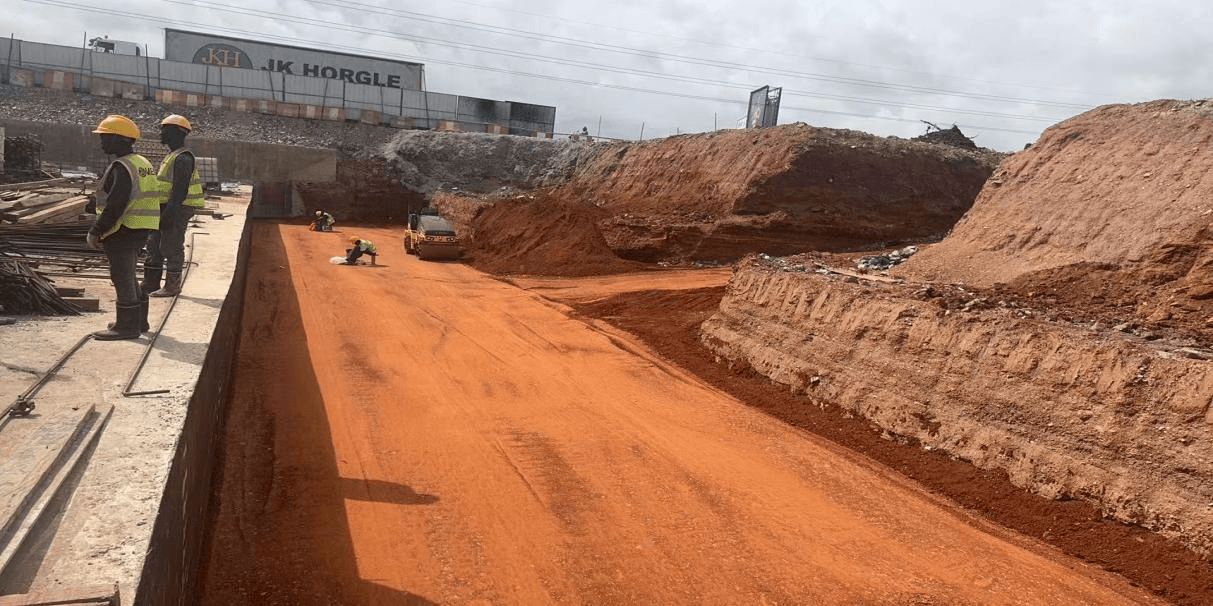
Section 1, the 19.5 km Accra–Tema Motorway, is the length currently under construction.
When will Section 1 be finished?
The contractor commenced on 2 August 2024, starting a 36-month construction window. Scheduled completion is 2 August 2027.
How much of the work has been completed?
Overall physical progress for Section 1 stands at 52% as of August 2026. Progress is reported structure by structure on the progress page, sourced from the Progress meeting, 28 August 2026.
Is the corridor open while construction is under way?
Yes — the works are being built along the existing corridor while it stays in use, which is why traffic-diversion works form part of the current project. Day-to-day lane and closure information is not published on this site; it is issued by the works teams on the ground.
Why is the road being reconstructed rather than resurfaced?
The existing pavement was designed for a 20-year life. It now shows fatigue cracking, joint failures, pumping under wheel load — damage that a resurfacing would not resolve.
What is actually being built?
The corridor is rebuilt to 10 lanes — 4 lanes of reinforced concrete freeway and 6 lanes of urban highway. The works scope covers:
- Reconstruction of the Tetteh Quarshie Interchange.
- Construction of new interchanges at Teshie Link, Community 18, and Lashibi.
- Construction of 10 pedestrian crossing points.
- Enhancement of roadway traffic in the Lagos Avenue / Lagos Link area.
- Rehabilitation and widening of Liberation Road to Polo Club, with overpass.
How is the project funded?
Ghana Infrastructure Investment Fund is the Funding Agency. The contract price is US$338.9M contract price before tax. Approved variation to the contract price as of August 2026 is Nil.
Who is responsible for the works?
A.T. Expressway Ltd. is the Concessionaire/Employer — it commissions and oversees the works, it does not build the road. The delivery chain is:
- A.T. Expressway Ltd. — Concessionaire/Employer
- Ghana Infrastructure Investment Fund — Funding Agency
- Ghana Highway Authority — Employer’s Representative
- Associated Consultants Limited — Employer’s Representative’s Agent
- Maripoma Enterprise Limited — EPC Contractor
Who do I contact about property or utility disruption?
For property or utility disruption along the corridor, please contact Associated Consultants (ACON) (opens in a new tab), the Employer’s Representative’s Agent for the project.
Will the corridor be tolled?
Portions of sections 1 & 2 will be tolled but not the entire stretch. Section 3 will not be tolled.